Pages

Monday, December 27, 2021

Season 2 in Loreto, Mexico: Friendships & Memories at Roca Blanco, Isla Carmen, and San Juanico


Our steadfast friends for several months: George (far left), Sara, and Dominique (D's husband, George, stayed behind on this exursion)


“There is the hidden presence of others in us, even those we have known briefly. We contain them for the rest of our lives, at every border that we cross.”

                                                                                                     --Michael Ondaatje, Divisadero


    Season II on S/V Flying Free was highlighted by friendships—new and old. As I continued to teach online, living my life in the “Captain’s lounge” Monday through Thursday in Puerto Escondido, Kevin would work on boat projects and converse with other sailors outside the marina office and stores, a casual gathering place strewn with hardy wood picnic tables.

    The communal aspect of sailing is something many, many sailors have written about, so our story is not rare. But the friendships we made had special significance since—unlike Season 1—we had a permanent home base for 5 months near the town of Loreto at the Puerto Escondido marina, perched about halfway down Baja and facing the crystal blue water of the Sea of Cortez. Most sailors here come and go, some only passing through for a weekend. However, we ended up parking our truck camper in the open dirt lot behind the marina; it is here where we met Dominique and George, a couple who has been traveling to Baja for over 15 years. They, too, have a truck camper, and they tow a small fishing boat from Oregon every year down to PE, where, last year, they bought a trawler that is also tethered to one of the many mooring balls in PE.


View from my "office" window


    Our friendship with them began with their stories. We have observed that sailors are a motley crew of people; the obsession with weather is the only commonality once you lean in to hear people tell their story of how they arrived, on a boat, in the middle of Mexico. The simple but very unique narratives of individuals include solo male and female sailors, couples in their 30s who decided to buy a sailboat and work on-the-go, couples in their 70s who arrived at the Sea of Cortez and never left, couples—like us—who split their time between sailing and returning “home” as their family obligations permit.

    Dominique and George have called France, India, California, Oregon, Hawaii, and Mexico their home…wandering when the water and adventure call them. With her thick heavy French accent, Dominique, a 70 year old power house with lean, musculature lines outlining her frame, is a true athlete and would regularly kayak alone 11 to 15 miles across the expanse of the Sea to the nearby island called Isla Carmen. She and George also invited us to snorkel and fish around Roca Blanca, two rocks surrounded by a healthy reef, located about 2 miles from shore (it looks and felt like it was smack dab in the middle of the Sea). Lemon sharks are known to populate this area, so jumping out of their small fishing boat into this reef and open ocean made my heart rate jump into my throat—but Dominique showed no fear, so I wasn’t about to hit the pause button when she led the way. The underwater view was so worth it—this was my favorite snorkel spot of the season (and K and I spent a lot of time snorkeling and diving this season).


George at the helm of his fishing boat


Fearless Dominique

I am definitely following her!


While we snorkeled, Kevin and George tried their luck!


    After exploring Roca Blanca, our day with them included freshly caught Cabrilla (Sea Bass), a fox sighting, and tales of Dominique hiking solo into the brush on the remote Baja beaches to find “ar-tee-facts” hidden in the caves amongst the low-lying hills inland of the beaches. Their love of books, of words, of the ocean, of exploring Baja on both the Pacific side and Sea of Cortez side lit our imaginations and reminded us of what a life of adventure between two people can inspire; Dominique and George have spent 50 plus years of marriage exploring oceans and land—so when D asked us if we wanted to hike in the Sierra de la Gigante mountain range, at a trail called Ligui Canyon (or Mesquite Canyon), we didn’t hesitate.

Dominique: “Stacy, you must remember to bring water shoes and a bikini on our hike; we will be crossing many rivers and even jumping into pools of water as we traverse the trail.”

    Hiking various trails became our land adventure as the Northers (the very windy days that swept down the Sea of Cortez from Arizona, bringing uncomfortable sea conditions) took over from mid-January to mid-March; the windy events were by no means constant—but when they occurred, they spanned several days and kept sailors busy with boat chores and/or land activities.

    What we thought would be a two hour hike through this narrow canyon (reminiscent but more beautiful than the Narrows at Zion National Park) became a four-hour epic adventure. Why? Dominique is so fearless and such a mountain goat that I, Kevin, and our other two friends, Sara and her husband, George (#2), took twice as long as D to cross the multiple streams and pools of water. The water levels were unseasonably low, according to D, but see the pictures. It was worth the murky crossings and rope rappelling we did to reach the last pool of deep water (I just had to ignore my niggling fear of water snakes as we criss-crossed the stream.)

First big pond where we stopped for lunch


Sara and George, our constant companions


The last big pool before the end....


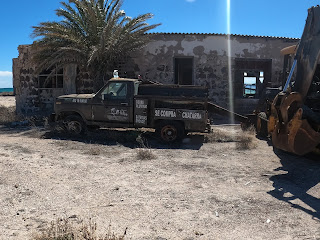
    Dominique and George shared their love of the surrounding area, including beautiful anchorages, like Bahia Salinas, where the water color, white sand beaches, and small camp accomodations for current-day Big Horn Sheep hunters on Isla Carmen gave us plenty to see and explore. Below: pics include relics from a former salt mine village and our snorkeling/SUPing.




    Really, we met so many people during our 5 months in Puerto Escondido that I finally understood the power of cruising—of being on the move while simultaneously fostering wonderful conversation and activities with like-minded individuals.

    Two more people we finally re-met were Virginia and Robert Gleser, authors of Harmony on the High Seas and regular cruisers of the Sea of Cortez and Mainland, MX for the past 16 years. Their book was one of the most important cruising books we read in preparation of our sailing journey—in short, because Virigina writes about the importance of communication—especially for couples—on a small cruising vessel. We met them at the Richmond boat show in Spring of 2019, a few months before our maiden voyage to Mexico. We listened to their presentation at the show, an extension of Virginia’s book, an eloquent and informative homage to the art of couples’ communication while cruising. In this cruising “guide,” Virginia discusses the importance of couples expressing their expectations, anticipating anxiety—and how to mitigate it—and working as a partnership in a confined space.

    Virginia and Robert anchored near us in San Juanico, where we had no Internet service for a week during my Spring break (so we had 10 wonderful days without me checking my phone). At this anchorage, a lovely bay with great hiking, snorkeling, and an authentice working ranch where we stocked up on fresh veggies and goat cheese, we had an evening cocktail hour with them; the next morning, Robert and Virginia cruised over in their dinghy. The conversation—and kind directness with which they approached us—I will never forget:

Robert: “Virginia and I want to talk to you about you:  your styles and communication. Would you like some free advice?”

    K and I agreed, of course, because even though I understand there can only be one captain aboard a ship, I have struggled to find my “place” on our boat—even after 3 years of working together; after all, Kevin is the experienced sailor; he is the one who can fix anything (and I mean everything—there is no help he needs with maintenance); and while I have become a capable first mate both at the helm and in the galley, I still feel like I should have a more important role. You couple my independence with Kevin’s role in calling the shots in everything he has done for the past 20 years (as a long-serving Sergeant with the CHP), and we have been two very strong-willed individuals slowly learning that our time aboard FF is not just about working together collaboratively (we can do this); but we *see* things in very different ways—hence, the very normal dis-harmony aboard the boat on occasion.

    So, without getting in to all of the details, they shared twenty years of wisdom with us—when they could have been out exploring or doing any number of things. And they did so with kindness, with compassion, and with a forth-rightness that made us feel so much gratitude and love. Virgina and Robert--along with Dominique and George--are reminders of the reward that comes with taking risks and embracing adventure as a couple.....that old adage, "the couple who plays together, stays together," stood before us in the form of couples all season long.  

San Juanico: one of our favorite anchorages of the season!


Cruisers' shrine, with our S/V FF addition


Entire bay of San Juanico

The beloved local ranch, a short hiking distance from the anchorage.


One small section of fresh veggies, available for purchase


Amazing fresh goat cheese!


Next up: the friendship memories continue…..I will share more adventures with our friends, Sara and George, and the biggest celebration of all: a 50th birthday bash with Stacy's high school buddies!


Tuesday, March 17, 2020

Sayulita to Mazatlan to the Sea of Cortez: Nov. 30-Dec. 15


Hidden Phantoms and Triangulated at Sea: Banderas Bay to the Sea of Cortez
November 31, 2019-December 12, 2019

“Slowly, I learned to trust [the boat’s] strength. Every time she rose to the top of a crest, I would hunch up in the cockpit under the scant protection of the sprayhood and hold on. She would pause, almost suspended in midair, before dropping down in the deep trough. My stomach was in my throat as we nosedived and slammed into the sea, only to begin the ascent again.”
                                                                        --Tania Aebi, Maiden Voyage

     Maiden Voyage is one of the first sailing adventures I read about after Kevin began teaching me how to sail. One of the youngest solo circumnavigators, Aebi happened to be an 18 year old young woman. Her story is raw and harrowing, and I remember wondering as I read her story how I would react when we encountered a similar situation as the one described above.

     Notice I didn’t write “if” we encountered such weather….

     I knew it was only a matter of time. And on our passage from Mazatlan to La Paz, crossing the Sea of Cortez, Abei’s words became our reality.

     Before this crossing, however, Kevin and I spent our first time alone together on the boat after Quinn flew home and before all 7 of our kids arrived in La Paz.

     Our first trip happened to be where we could not anchor, in Sayulita. This surfers’ paradise is a short 45 minute drive from La Cruz, where we were anchored for a couple of nights. We decided to Uber after we checked the incredibly cheap price: exactly $9 each way. (As a side note: Uber was cheap everywhere in Mexico. As an example, we would regularly head to a grocery store 20 minutes from our marina in La Paz, and invariably, we would only have to pay about $3 one way. Yes, 3 bucks! But Uber drivers work surreptitiously…meaning, you will not see an Uber sticker anywhere on their car; the local taxi cab drivers have been known to pull Uber drivers out of their own car and beat them up. The competition, in other words, is fierce).

     Sayulita was equal parts jungle, crowded coastal beach, and hippie-meets-California vibe. Which explains the crowding. It was quaint, and we loved browsing vendors’ homemade sandals and jewelry—but I can see why so many locals and cruisers mentioned Californians taking over the town. It was probably the most crowded small town we experienced in Mexico. But the highlights included a vibrant cemetery, a beautiful hot pink church in the main plaza, and swaying multi-colored banners adorning the streets, drawing visitors’ eyes upwards.


     After a couple of days, we left Banderas Bay for good and headed North toward Mazatlan. Before we got there, however, we decided to stop at a small village/anchorage called Chacala. Perhaps the beauty of this town was that we had no expectations of it. We read briefly about it in our cruising guidebook—but otherwise had little information.

     There was only one other sailboat when we arrived, and the couple aboard gave us various tips about the area. The first piece of advice: there is no need to beach the dinghy when a small, nondescript beach on the northwest end of the jetty, near the local panga boats, offers a great parking spot. Also, this couple gave us local knowledge about several hiking spots, which we took advantage of (see the pics from the top of the ridge line). Our main hike to the top involved broken communication with a sleepy gate guard (he eventually tired of our lousy Spanish and gesticulating handwaving), and it’s the first time I have ever stopped dead in my tracks on a hike and refused to go any farther. The long/short story is this: I will try anything, and I’m not one to give up on something that challenges me, but I hate snakes more than Any. Other. Thing. We had gotten off our makeshift dirt path and were wandering through someone’s orchard (see the pic of the bread fruit) when the ground was no longer visible; covered with dense grassy muck at least a few feet deep, the orchard floor only made me think: “I’m going to step on a snake…and then we’ll be too far from anyone or anything [for help]….and then I’ll hyperventilate because I’ll worry that the snake is poisonous…and”—well, you get the picture. We had also been told that alligators lived in the adjacent “pond,” so my slippery slope thinking sealed my fate. We headed back down from where we came, creating our own trail until we reached the bottom, where there is a coastal yoga retreat, complete with guided paths back to the beach. Whew.

     The rest of our time in Chacala was leisurely. We enjoyed stand-up paddle boarding, getting to know the local workers at the various palapa restaurants (Hector, an 18 year old waiter, shared his story of fleeing the violence and mayhem of Venezuela and finally finding refuge in this sleepy town), and we joined an entire fleet of cruisers and ex-pats at a local brewery called Onda. Onda offers about 10 different craft beers, some of the best we’ve ever had; an American couple, who divides their time between Chacala and Alaska, owns this place, and it is open only a couple of nights a week. We actually stayed an extra night in Chacala because we heard such great things about this place. We mingled with fun, insightful cruisers in an atmosphere reminiscent of an old friend’s candle-lit living room, but the distinctly non-Mexican beer (aka more than 5.0% alcohol) made us glad for our decision.


A few more boats showed up!


Triangulated in the Open Ocean: Our Overnight Passage to Mazatlan

     We enjoyed perfectly calm, warm days and evenings on our way to Mazatlan. Most of the time we simply motorsailed, hugging the coastline in about 18 to 30 feet of water. We kept noting the shallow depths, wondering whether we should give wider berth from land, but the truth was, land looked pretty far away. Our radar and naked eye discerned one finger of land pointing due west; this point looked like a reef—even though we clearly saw a light of some kind on the stretch of sand. An occasional panga boat would speed past us going the opposite direction…then, one became three or four. We could see the bright orange waders filling the lower half of the boats, clear indicators of fishermen cruising  their territory in search of their livelihood.

     However, a curious thing happened: we noticed 3 pangas on our starboard (right) side, maybe a mile from our vessel. Then, within about 10 or 15 minutes, one panga was behind us, one was in front of us, and one had ended up on our port (left) side. Meanwhile, the panga boat on our left had slowed down and was furiously flashing us with a light; within a couple of minutes, we could see the flashlight beam nodding up and down, like an overzealous toddler flickering a light switch on and off. I had come up from the galley below when I saw the two men, now about less than a quarter of a mile off our beam.

     “Oh crap,” I said to Kevin. “Why the hell are they flashing us?” What I meant, of course: “What are we supposed to do? Is this a trick?” Pirates came to mind as I noticed that Kevin, at the helm, had not slowed down at all. Being the perfectly calm personality that he is, Kevin simply said, “I’m not sure what they want. . . .”

     While one fisherman flashed his beam, the other guy was quickly hauling up what looked like buckets-full of fishing line. Within a minute, with both fishermen standing in the panga and yelling at the top of their lungs, they charged toward us, cutting us off at the bow. Or, at least they tried to cut us off. The reality was that our vessel was four times bigger than theirs—but their actions were loud and clear even if their words were not. We pulled back our power but did not kill the engine entirely. I noticed the setting sun while I did a quick inventory in my head of everything I should grab down below (knife? definitely the wasp spray, handheld radio…you get the idea: I wasn’t thinking twinkies or cheap t-shirts, items sailors might bargain in an exchange with locals).

     As the panga crossed from our port to starboard side, Kevin left the cockpit to look over the railing to see whether we had crossed their fishing line. Meanwhile, the fisherman was making a circle in the air, an indication of our prop, we presumed. Kevin noticed a black-looking buoy behind us…and we both pointed toward our stern and shook our heads as if to say, “no, we didn’t cross your fishing line.”

     “Esta bien,” I kept saying. “It’s okay.”

     These two guys finally relaxed and nodded in friendliness to us. 

     That night, on the radar, we noticed about 18 dots, all lined up together and running parallel to the mainland. I asked Kevin about these because I didn’t know if I was looking at land—I thought maybe something was wrong with our charts. It turns out, the row of dots was a fleet of shrimping boats. Of course. The intrepid fishermen, combined with the shallow depths, finally made more sense (as did the rumors of a shrimping shortage). We have since learned that these fishing lines, running from close to land due west, are almost four or five miles in length; avoiding the lines and shrimpers means giving the land wide berth and, therefore, lengthening the passage to Mazatlan. Once we finally arrived, we enjoyed our time immensely! We would not recommend Isla Mazatlan, but the absolute best restaurant of our entire 3 month trip in Mexico was there at the Marina/hotel: it’s called Tostaderia.

On high alert for more panga boats.
We arrive in Mazatlan


_________________________________________________________________________

Crossing the Sea of Cortez

     After listening to various cruisers’ nets throughout mainland Mexico, one thing we realized was that cruisers on the radio typically attempted to dissuade fellow sailors from hitting the open ocean if the wind was forecasted above 18 knots. Our boat happens to love 20+ knots of wind, which we knew from our almost two years of sailing on the Central Coast of California. Some of our best sailing days consisted of at least 25 knots (especially when the rollers steaming toward us from the far Pacific horizon were less than 6 feet; and very rarely did these bumps occur in succession, say in anything less than 4 or 5 second intervals). So when we listened to the net the morning we left the harbor, we were not concerned—we actually relished the 18 to 25 knot forecast. The waves were not forecasted above about 4 feet, so we thought we had a perfect window to cross from mainland Mexico to La Paz, about a 275 mile, two-night journey.

     Our first 24 hours proved idyllic, except for one important problem: we had heard a strange snap in the cockpit that morning before we left the marina. Neither of us could identify the problem, so we decided after looking around that it [the sound] should not hold us up. Unfortunately, as Kevin was unfurling the genoa (forward sail, the “big” one), he noticed the luff was slipping from the foil (the sail was sliding past the railing toward the water). So Kevin quickly furled the sail, hoping the jib sheet would secure it “enough” to keep it from going anywhere. The sail we use most was effectively paralyzed. Our first evening, December 11th, remained calm and uneventful.

     The wind and swell picked up in the morning, with sustained 18 knots but gusting up to 28 knots. However, the swell—specifically, the type of swell—is what we noticed. With short periods (3 to 4 seconds between waves), the waves reminded me of a witch’s hat: broader at the bottom, narrow at the top, and certain waves would curl at the tip, folding over to push more white water toward our bow (or slightly right of the bow as we tried to stay at a 45 degree angle); we were bucking current and short-period swell and usually riding one wave to another, which elevated us above the baseline of water— like a crowd surfer being passed from one person to the next at densely packed concert. But then the inevitable would happen: the waves would spread out, say at 6 or 7 or 8 second intervals, and our wave riding would end with a seriously jolting crash, making our bow hit a deep trough, sending a reverberating thud through the hull. Aebi had captured the feeling in this scenario well.

     I remember thinking of the witch’s hat, of seeing white tendrils against a blackboard of pure dark peaks rising above the railing and heading toward our bow, on December 12. I looked at the clock: 12:12 a.m. exactly. The full moon had sprouted above our stern in the early evening, but the glow from its light only permeated the water behind us (the opposite direction). I was learning faith in our boat at the same time I was doubting my ability to steer us into the black abyss if our autopilot failed. Like Aebi, I was simply holding on.

     But I had Kevin. With two hour watches, we would pass each other in silence, exhausted from the constant jarring and seesawing….both of us leaned on the other in a way we had not done before (with sailing). After 30 hours of the same intensity, we crossed the Lorenzo channel between La Paz and Isla Espiritu. As soon as we rounded right toward Espiritu, the wind and waves shut off, and we glided toward one of the most beautiful places I had ever seen: the turquoise green water of Ensenada de Raza.

The best reward after 30 hours! (and note the awkwardly furled genoa!)